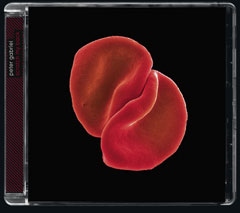
Saturday night at the 2009 WOMAD Festival and it was the unlikeliest way to open the headline set. The band were in place, the audience expectant and the odd special effect or two was poised to be triggered once the drums kicked in. But rather than launch into a high-tempo favourite from the back catalogue, Peter Gabriel instead opened proceedings with a drawn-out version of Paul Simon’s The Boy In The Bubble – unexpected, poignant, deeply moving. It was the first whisper of his new project – Scratch My Back.
“Songwriting is what drew me into music,” Peter reveals. “The craft and the process of putting together a good song seemed both exciting and magical.” And it’s this magical craft that Scratch My Back salutes, a dozen covers of songs that Peter regards as among the pinnacles of songwriting endeavour. “Songwriting is what turns his crank,” agrees long-standing member of his management team Mike Large, “and there’s a whole bunch of songs that, when he hears them, the meter goes off the end of the scale.”
There are several rather familiar songs that Peter interprets on Scratch My Back. Aside from The Boy In The Bubble, he revisits David Bowie’s Heroes, Radiohead’s Street Spirit (Fade Out) and Randy Newman’s I Think It’s Going To Rain Today. But the songbooks of artists who’ve only emerged in the last few years have also been drawn from, among them Arcade Fire (for My Body Is A Cage) and Bon Iver (Flume).
The project is groundbreaking for two reasons. Firstly, it’s a collaboration. All the artists whose songs Peter has recorded here are returning the favour by each recording a song of his. The fruits of this exchange – or song swap – will be heard on a forthcoming companion volume, I’ll Scratch Yours. “The intention,” explains Peter, “was that we would each do the songs in our own idiosyncratic way.”
Secondly, these songs have been approached from an angle that’s rather revolutionary. Peter’s usual band have been dispensed with on this project, leaving his voice accompanied solely by orchestral instruments. The approach makes for some radical reinterpretations. “After all,” protests the album’s arranger John Metcalfe, “what’s the point of covers that don’t make any effort- So many are just really the same song with a different singer. Here was an opportunity – particularly as it was orchestral – not to do that, to reinterpret these songs with integrity.”
So how did the list of potential songs – at one point numbering over 100 – take shape? Peter’s neighbour Dave Bates, a former A&R man by trade, acted as what the album’s engineer Richard Chappell refers to as “the song stimulator. He came around and plugged in these two iPods and we’d bounce from song to song, slowly putting this list of songs together.” Richard was responsible for suggesting the Arcade Fire and Elbow tracks, while Peter’s daughter Melanie nominated the Bon Iver song, which would later draw out an extraordinary performance from Peter.
The final 12 songs serve as an insight into his listening pleasures. “Peter surprises me,” explains Mike Large, “because he seems to have heard everything, but you never catch him listening. I do wonder whether he plugs his brain into his radio at night somehow. He’ll have heard all kinds of music but I’ll have never been able to work out when he’s heard it.”

And singing other songwriter’s words isn’t a problem. Inspired by other radical covers – like Johnny Cash’s deconstruction of Nine Inch Nails’ Hurt or Stina Nordenstam turning The Doors’ People Are Strange on its head – Peter was actually liberated by not having to write the song itself. “Doing a covers album gives Peter more creative freedom,” suggests Mike. “Starting from a finished song, he’s able to apply all the creative energy on the arrangement.” Peter would agree. “It’s easier to find holes in the wall than it is trying to build out of nothing.”
With the help of pianist Jason Rebello, Peter stripped each song right back to their core skeleton before the services of arranger John Metcalfe were called upon to tastefully clothe the basic tracks. “I asked John to keep the arrangements simple, stark but always emotional, so that the songs could really be heard and felt.” John, renowned from his work with the Durutti Column, Blur and The Pretenders, relished the opportunity. “I was a kid in a sweet shop! Here was this incredible voice and here were these incredible songs. It worked straight away. I had Peter’s vocal and a totally free hand to do what I wanted. And I did.”

“John was almost Peter’s software,” explains Richard Chappell. “Normally we’d work with ProTools or something. Now John was the interface.” After much to-ing and fro-ing between John’s base in Oxford, Peter’s home studio in West London and Real World HQ in deepest Wiltshire, the project developed into a coherent yet varied collection of songs. “Where the album hits home,” says John, “is in its variety and breadth. Some songs are very close and intimate, some more epic-sounding.”
All of those involved in Scratch My Back‘s patient evolution – including input from legendary producer Bob Ezrin who, says Peter, “would come in like a SWAT team” – are clearly delighted with the results. “It surpasses what I thought it was going to sound like,” declares Richard. “It sounds amazing. Peter sings so well on this record and all of these songs tell particular stories. They all put you in a different place.”
The songs
Heroes
The best-known song on Scratch My Back and therefore quite probably the bravest choice as the record’s opener, this Bowie anthem is slowed right down, in the process shorn of its confidence and swagger. But the melancholy begins to evaporate as the song progresses, the scurrying orchestrations raining down columns of sunlight by the close.
The Boy In The Bubble
Another audacious choice and again the pace is near-funereal and the arrangement sparse. Stripped of the bounce of Paul Simon’s original, the song takes on a contemplation and poignancy that wasn’t always apparent. When Peter sings “These are the days of miracle and wonder”, the incredulity in his voice is nothing short of palpable.
Mirrorball
“Dawn gives me a shadow I know to be taller / All down to you, dear.” It’s abundantly clear why this song, one of the highwater marks of Elbow’s Mercury Prize-bagging The Seldom Seen Kid, holds such appeal for Peter. With Guy Garvey’s poetic pen producing swooning lines like “We kissed like we invented it”, John Metcalfe’s surging strings are the equal, giving Mirrorball the big-screen sheen it truly deserves.
Flume
Quite possibly the revelation of the entire record. A song originally recorded by Justin -Bon Iver’ Vernon in the solitary confinement of a snowbound Wisconsin cabin has been utterly transformed. Now the recipient of a grand, near-symphonic treatment, Flume is rewarded by Peter’s soaring voice heading towards the heavens, albeit shot through with pain and desolation.
Listening Wind
On the records of Talking Heads, there was sometimes the danger that David Byrne’s lyrics might get lost in the band’s clever, multi-layered arrangements. Here, on one of the less celebrated songs from their 1980 masterpiece Remain In Light, things are distinctly less cluttered. The song takes a measure of the confusion of a changing world (“He feels the presence of the wind beside him / He feels the power of the past behind him”), revived here by Peter’s insistent vocals, pushed along by urgent gusts of strings.
 The Power Of The Heart
A recent Lou Reed composition, Peter abandons its author’s trademark gravelly delivery for an open vocal performance that, backed by unobtrusive piano and sympathetic orchestrations, places great emphasis on the song’s uncomplicated but moving melody. Simple things can be the most profound.
My Body Is A Cage
One of Peter’s more recent discoveries, Montreal’s Arcade Fire have forged a reputation for the intensity of their performances. Nonetheless, on this track from their astonishing Neon Bible album, Peter has ratcheted the intensity still further – an interpretation every inch as claustrophobic as the incarceration alluded to in the title.
The Book Of Love
Originally recorded by Peter for the soundtrack of the movie Shall We Dance-, this is, like the Bon Iver track, another cult classic afforded the grand, cinematic treatment. One of the stand-outs from The Magnetic Fields’ three-disc opus 69 Love Songs, here deeply romantic strings remain unceasingly faithful to Stephin Merritt’s perceptive dissection of love’s simplicities.
I Think It’s Going To Rain Today
The straightest cover on Scratch My Back as it retains Randy Newman’s original goosebumper of an arrangement. The revelation is Peter’s vocal conversion into something approaching the jaded barfly who inhabited Tom Waits’ ’70s records, the perfect narrator of lines like “Tin can at my feet / Think I’ll kick it down the street / That’s the way to treat a friend”.
 Apres Moi
This reading removes the insularity of Regina Spektor’s original – all spiralling piano and spiky vocals – and gives it a true platform, right from the opening flurry of brass and woodwind that sounds not unlike a high-drama film score.
Philadelphia
Bruce Springsteen’s contribution to the soundtrack of Philadelphia was the more celebrated, but this Neil Young track was surely the most beautiful. This version marks Scratch My Back’s tenderest moment, its gently undulating melody matched by the empathetic delivery of Young’s lyrics. Gorgeous trumpet solo too.
Street Spirit (Fade Out)
The album’s closing song is also its most unrecognisable – even the most hardcore Radiohead fan would take quite some time to identify this, the final track on The Bends. Every drop of angst present in the original remains, but the discomfort of a young adult in an overbearing world has been replaced by more middle-aged existential despair.
By Nige Tassell